SWIM FASTER: BACKSTROKE
Mastering the Backstroke for Speed
Students who reach the Backstroke milestone will:
- Push themselves to set a personal best time
- Learn more about streamlining and minimizing drag
- Get detailed instruction on positioning
- Standard for mastery: Backstroke with pattern stroke, turns and finishes: goal time x 1 lap for respective pool
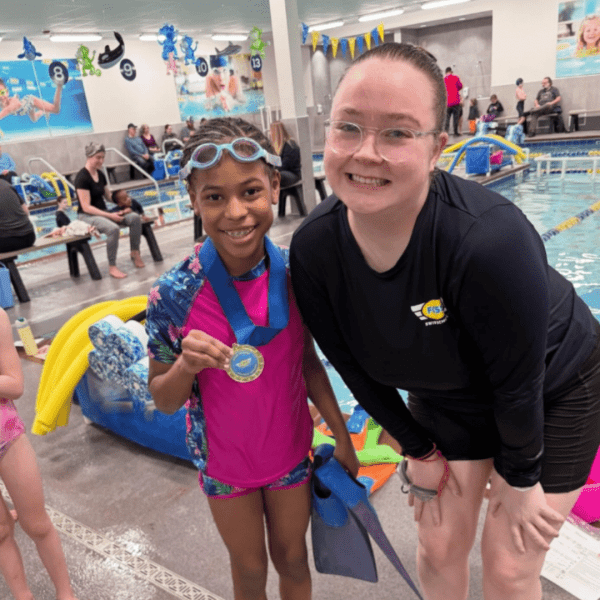
In the Swim Faster program at Foss Swim School, students are coached to achieve four speed-based milestones, one for each of the four competitive strokes. The class is set up more like a swim team than a lesson – coaches are on the pool deck giving direction, not in the water, and the sessions are longer, with more time spent swimming laps to build endurance.
Also, unlike other FOSS programs, in Swim Faster, milestones might not be achieved in any particular order, and a student does not need to complete one milestone to start the next. But while swimming the backstroke faster doesn’t require meeting the time standard for the freestyle first, increasing speed in both strokes involves many of the same principles.
Moving Water Efficiently
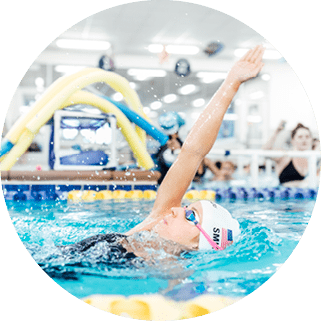
As with freestyle, the key to swimming the backstroke is to move the most water with your hands and feet while expending the least energy. Once you have achieved maximum efficiency through form, you can add speed to your stroke or kick to make you faster.
To maximize efficiency in the backstroke, swimmers are coached on five elements that are common across all strokes:
Propulsive Hands and Feet
To catch as much water as possible, focus on stretching as far out as possible, and hold the flat of your hands perpendicular to the water’s surface throughout the stroke to catch as much water as possible. Keep the toes pointed to maximize the area pushing water, but don’t make the kicks too big or too close to the surface to avoid wasting energy.
Recovery
When bringing the opposite arm forward, the same lesson taught in Learn to Swim still applies – reach up as far as possible (or “paint the ceiling,” as we call it). You want to chop your hand into the water with the edge and enter cleanly, with minimal splash.
Streamlining
Keeping kicks tight, the head flat, and the midsection high maintains the most streamlined cross-section possible.
Timing
Once a swimmer has an efficient stroke, the goal is to get arms and legs operating in concert but at different speeds – 5-6 kicks per second, two arm strokes (left and right) every second or so.
Breathing
Breathing in the backstroke is easier because it doesn’t require lifting the mouth out of the water, but it’s still important to build lung capacity and stamina to supply oxygen throughout the swim.
The Swim Faster Levels
Is Swim Faster right for your student? Since this program (level Big 6 in our Swim Path) assumes students have mastered the four competitive strokes and are familiar with turns, finishes, and swimming longer distances, we recommend a Preview Lesson to assess skills unless you are joining from another FOSS program.

The Swim Faster Levels
Is Swim Faster right for your student? Since this program (level Big 6 in our Swim Path) assumes students have mastered the four competitive strokes and are familiar with turns, finishes, and swimming longer distances, we recommend a Preview Lesson to assess skills unless you are joining from another FOSS program.

Achieving the Backstroke Milestone in the Swim Faster Program
Over the course of a quarter, Swim Faster swimmers will work on these improvements to swim a personal-best time and will pass the milestone once they surpass the target time for backstroke.
After that, swimmers can work on other stroke milestones or sometimes return for another quarter of Swim Faster to improve speed further. It’s all about what swimmers want to achieve, and represents the ultimate culmination of their Swim Path journey with FOSS!